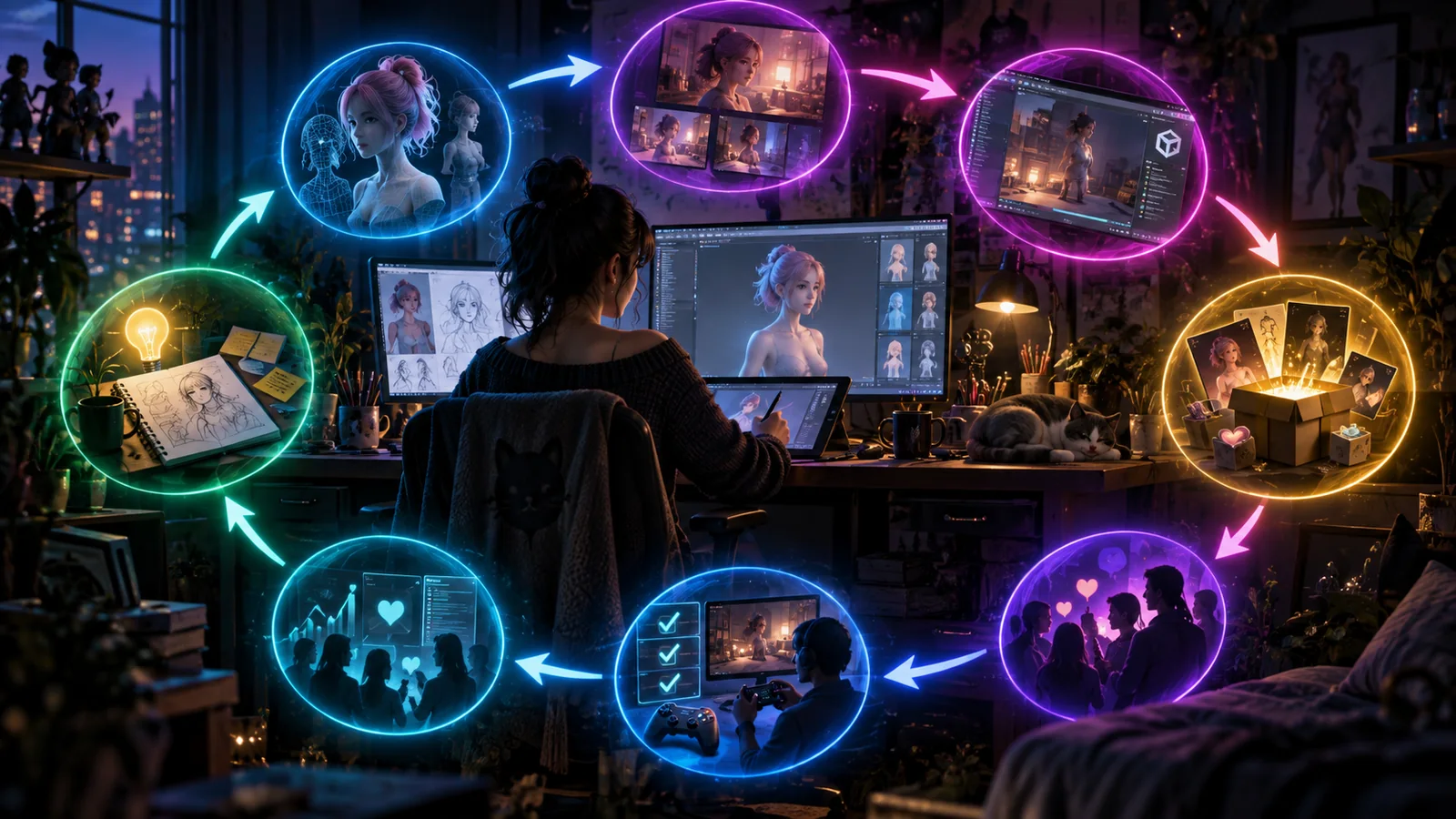
The first release has to pay for the next one
Imagine a small team with a playable opening, a cast people like, and a story much larger than the current build. There is enough to demonstrate the idea, but finishing it means months or years of writing, art, programming, and testing. Someone has to fund that time before there is a complete game to sell.
Savings, freelance work, publishers, grants, and conventional crowdfunding can all finance development. Recurring memberships offer another route: release something worth following, invite players to support the work, and use that income to keep producing it. The team can begin earning while its largest expense, development time, is still accumulating.
Our central argument is that recurring support makes the ongoing process part of the offering. A supporter may want the newest build, but also the previews, progress reports, community, and chance to help a particular game reach its next chapter. This is an analysis of the model's incentives, not an earnings survey or a claim about every adult developer.
What the membership actually buys
One creator offers a build a few days early. Another separates preview, supporter, and public releases by several weeks. Others bundle polls, development notes, art, credits, or community access. Patreon's own membership guidance includes early access and community benefits, but the creator sets the actual offer. There is no universal adult-game subscription package.
The distinction matters at checkout. Funding ongoing development does not automatically include a future Steam key, every expansion, or access to membership posts after cancellation. We check the promised benefits, billing terms, delivery method, and current playable content before joining. If those details are unclear, asking the developer is more useful than assuming a monthly pledge works like a store purchase.
Steam Early Access is also a different arrangement from a creator's early supporter build. Valve describes it as selling a playable game in its current state and explicitly cautions against using it as crowdfunding. A membership page and a store page can both support an unfinished project while making different promises to the buyer.
A small audience can fund a very specific game
A niche premise may struggle to attract a publisher or enough launch-day buyers to recover years of work. It can still inspire a smaller group to support it repeatedly. That changes which projects a creator can reasonably attempt, including unusual relationship stories, specialized simulations, and themes poorly served by mainstream stores.
Consider a hypothetical 1,000 supporters paying $5 each per month. That is $5,000 in gross monthly payments, not $5,000 in disposable income. Fees, refunds, taxes, contractors, software, equipment, and the creator's living costs all compete for it. Split the remainder across several people and the apparent success looks different again. These numbers illustrate the arithmetic; they are not reported earnings for any studio.
Recurring income can buy time and continuity, but it is not guaranteed salary. People join for an update and leave, household budgets change, and a payment problem can interrupt funding. A project can have enthusiastic fans and still lack enough predictable income to hire the animator or programmer it needs.
Why give away a game people are paying for?
A free public build lets an unfamiliar creator prove the game exists and gives players a way to judge its writing, art, performance, and compatibility. For an unfinished project, that confidence can matter more than a polished trailer. Some players will stay with the public version; some will decide the next chapter is worth supporting.
In a paid-first, public-later arrangement, timing becomes one of the benefits. Supporters help finance production and receive newer work sooner. A delayed public build continues finding readers, generating feedback, and bringing people back to the official page. A useful public build can serve as both a substantial sample and an invitation to fund more.
Neither the delay nor the free release is automatic. Some creators offer a limited demo, some publish older full builds, and some sell the game outright. We look for the creator's stated schedule rather than assuming that every supporter release will eventually become free.
This pattern is especially visible among games made with Honey Select, Koikatsu, and other Illusion-style Studio tools. Those character and scene tools let a small creator build a cast and render new chapters quickly. An older public build draws people in; paying supporters receive newer work sooner and fund the next round of production. Our read is that the arrangement also lets creators earn from ongoing development without putting a conventional price tag on a finished game built around those Studio assets. Many projects have operated this way without an obvious public challenge, although we cannot know whether the release model is the reason.
- Play a public build
Readers try the premise, writing, performance, and controls.
- Some become supporters
Memberships fund ongoing work and provide the stated benefits.
- The next build arrives
Supporters get earlier access if that is part of the offer.
- A public release follows
Where the creator offers delayed builds, the cycle brings in new readers.
The next update becomes a deadline
Monthly billing creates a recurring moment when supporters ask what their money made possible. An episodic story fits that rhythm: another chapter, another character event, another area to explore. A team can deliver a satisfying slice while the larger project remains unfinished.
There are practical benefits. Players find bugs early, creators learn which characters connect with the audience, and a long project can be adjusted before all its art is finished. The same feedback can expand the workload. A popular side character gains a route; a poll adds a feature; a minor location becomes a new hub. Each addition may please supporters while pushing the ending farther away.
Frequent releases also require packaging, announcements, support, and regression testing. Maintaining supporter and public versions can mean diagnosing an issue already fixed in a newer build, or explaining why a save will not migrate. The release schedule consumes some of the time it finances.
A better save system is harder to put in a preview

A new scene produces screenshots. Reworking a fragile quest system may produce no new scene at all. Yet the second task could determine whether the next twenty updates are possible. This is the sharpest tension in a model that rewards visible progress: some of the most valuable work is difficult to show.
Animation tools, accessibility, localization infrastructure, save migration, performance fixes, and asset replacement can all require a quiet stretch. If the team fears losing members during that stretch, it may keep adding content to a system that is becoming harder to maintain. Later, the repair is larger and more disruptive.
Clear development notes can help make that work legible. A creator can explain what changed, why it matters, and what it enables without manufacturing a dramatic update every week. As readers, we look for concrete explanations and delivered improvements, not simply a count of new images. No single metric captures the work behind a game.
Finishing changes the business
When the promised ending ships, supporters may feel their job is done and cancel. A creator who relies on monthly income has to plan what follows: a new project, expansions, a finished-game store release, continued community benefits, or a smaller operation. Completion can therefore create a real transition risk even when everyone wants a satisfying ending.
That risk creates an incentive to keep a successful development cycle going. It does not establish that a particular creator is deliberately avoiding completion. Long projects can reflect ordinary scope mistakes, part-time work, illness, technical debt, changing collaborators, or the sheer amount of production involved. Deliberate ongoing serialization can also be a valid product when it is described honestly.
There are incentives to finish, too. A complete game can earn recommendations from players who avoid unfinished work, build trust for the next project, and generate store sales. A creator who leaves supporters satisfied may be better positioned to launch something new. The important distinction is between an openly evolving series and repeated promises of an ending that never become more concrete.
The platform can change the plan overnight
A studio can control its script and release schedule without controlling how it gets paid or discovered. Membership services, storefronts, hosting providers, and payment processors each impose conditions. Losing visibility or payment access can hurt a project even if the next update is ready.
There is a documented example: in July 2025, itch.io announced that adult NSFW content had been removed from its browse and search pages following scrutiny from payment processors. Its announcement was later updated with a link to reindexing news. We cite this as a historical disruption, not a claim that all adult listings remain hidden today.
For a creator, the consequence is practical. A storefront may stop being an effective discovery route, membership income may become harder to collect, and supporters may need to find a replacement page. Maintaining an official site and clearly cross-linked accounts can help preserve that relationship, although additional channels bring their own maintenance costs and do not eliminate payment restrictions.
The file is only one thing supporters are funding
An unauthorized copy can make early access feel less exclusive, but it does not reproduce the funding that paid for the update or will pay for the next one. Supporters may be financing continuity, community, and a game they want to exist as much as access to a particular download.
We cannot assume every unauthorized download represents a lost sale, or that every public player will become a member. Both claims would need evidence. We can still choose to respect a creator's release terms and direct people to official builds. A deliberately free public release is an invitation to play, not piracy.
Support should remain a choice within the reader's budget. Nobody owes a developer an indefinite subscription. If membership is not affordable, sharing the official page, submitting a useful bug report, writing a thoughtful review, or buying a finished release can contribute without committing to another monthly bill.
How we decide whether to keep supporting
We begin with the work that exists: is the playable build worth our time, are the benefits clear, and do updates show progress toward the game being described? We then read the development history. Honest delays with specific explanations tell us more than polished promises alone.
We also ask what completion means. Is this a finite story, an expanding sandbox, a series of seasons, or ongoing experiments? Does the creator distinguish new ambitions from previously promised work? A changing plan is easier to trust when its costs and tradeoffs are acknowledged.
Concerns deserve specifics. Missed dates, broken advertised benefits, and unexplained changes are things we can document. A long version history, a large supporter count, or an unfinished label alone does not prove dishonesty. Reviewing the evidence is more useful than assuming either that every delay is a scam or that every criticism is unfair.
Support the future you want to play
Recurring support makes room for games that might never survive a conventional funding pitch. It also ties creative work to an ongoing relationship with people who expect progress. The strongest version of that relationship has clear benefits, understandable plans, room for necessary maintenance, and a credible answer to what happens when the current project ends.
Our recommendation is to support work we value through the creator's official channels, keep expectations grounded in what is actually promised, and respect public-release schedules. Better-funded production can make better games possible. Clear boundaries help both creators and players stay with the journey long enough to enjoy the result.