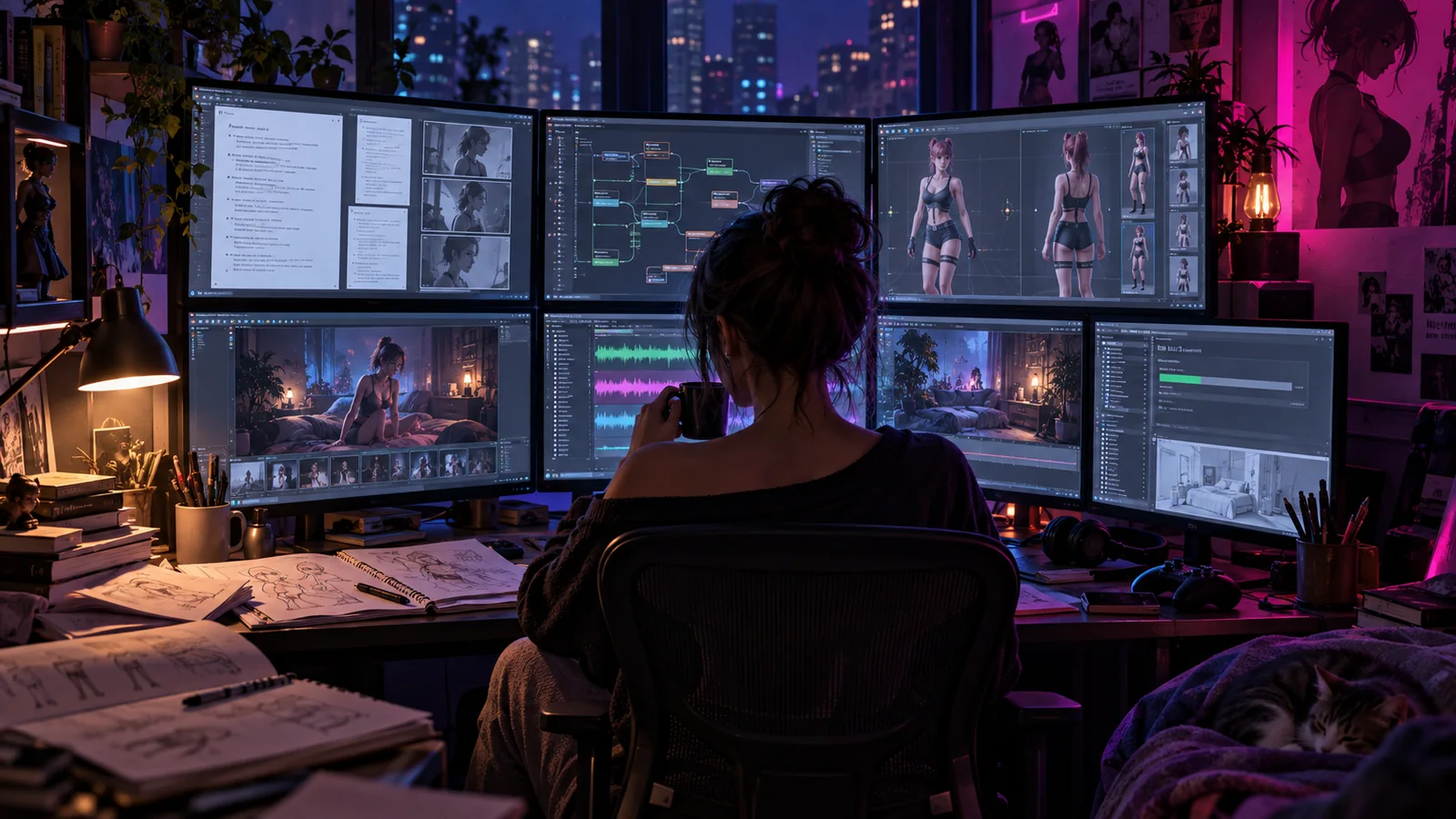
A game begins with a promise the team must repeat
Imagine a solo creator with a story outline, a handful of characters, and enough savings for a few months. The first scene is exciting. The fiftieth scene is a production system. Every update must turn writing into finished art, code, audio, builds, and support without exhausting the person making it.
That is why the visible style of an adult game often follows its workflow. A visual novel built from pre-rendered images can spend its computing budget before release and run on modest hardware. A real-time 3D game can offer free cameras and interaction, but the creator inherits animation, collision, lighting, performance, and hardware support. A 2D game needs an artist or a sustainable supply of illustrations. Each choice moves the labor rather than removing it.
The best tool is not the one with the longest feature list. It is the one that lets this team keep the promise of the game for the next update, the next year, and the final release.
The engine decides what comes cheaply
Ren'Py is the default choice for many image-led visual novels because dialogue, choices, rollback, saves, scene changes, and distribution are already part of the framework. A writer can reach a playable scene quickly, while an experienced developer can build custom screens, relationship systems, maps, and minigames in Python. The tradeoff appears when a project grows into a simulation whose state and interface exceed the simple novel structure it started with.
RPG Maker gives a small team maps, events, switches, variables, inventories, battles, and a database without asking them to create an RPG framework first. It is well suited to exploration games and event-driven adventures. Plugins can push it far beyond the default template, but every plugin becomes another dependency to maintain.
Unity and Godot are general-purpose engines for teams that need custom interaction, 2D or 3D gameplay, physics, or unusual interfaces. Unity has a large ecosystem and a long history in indie development. Godot is free and open source under the MIT license, which is attractive to teams that want an engine without royalties or proprietary project lock-in.
Unreal Engine is compelling for high-fidelity, real-time 3D. Blueprints let designers build event-driven gameplay visually, while C++ remains available for deeper systems. That power does not make content cheap. A small team still has to rig characters, build environments, animate scenes, control shaders, optimize performance, package large builds, and test many hardware combinations.
A visual novel is an assembly line for scenes
A typical pre-rendered scene begins as a script and shot list. The creator selects a location, loads characters, sets clothing and expressions, poses bodies and hands, places lights and cameras, renders stills or animation, corrects the output, compresses it, imports it into the engine, connects dialogue and choices, and tests every route that can reach it.
A single conversation can require dozens of images. An intimate scene can require far more because motion, continuity, camera changes, transitions, and alternate paths multiply the work. If the project supports name changes, relationship choices, different outfits, or optional content, the team must decide which variations are rendered and which are handled in text or code.
The result may look like a sequence of images, but the game underneath is a growing web of conditions. The engine must remember what the player saw, whom they chose, what time it is, which items they own, and what the next update should do with an old save.
Daz makes commercial pre-rendering approachable
Daz Studio combines posable characters, clothing, environments, expressions, lighting, and a large commercial asset market. A creator can assemble a cast without modeling every body and room from scratch, then render consistent 2D images and animations for a visual novel.
The licensing path is one reason Daz appears so often. Its current standard agreement permits publishing and selling ordinary 2D renders and animations made from licensed content, provided the underlying assets cannot be extracted. A separate Interactive License is relevant when the actual 3D content must be distributed inside an application. Product-specific restrictions can still apply, so the receipt and license for every asset remain part of the production record.
The convenience can become an exploding cost per character. A distinctive cast may require separate body and face morphs, skin, hair, anatomy, clothing, expressions, poses, and accessories for every major character. A new outfit or location is often another purchase. Clothing must still be fitted and corrected, custom items must be modeled or commissioned, and animation still needs keyframes, contact corrections, simulations, or additional motion products even when the base figure arrives rigged.
Daz can produce a polished, commercially straightforward visual pipeline that grows with a studio over the long term. The tradeoff is that building a large, visually distinct cast and enough locations to sustain a long game can exceed what many first-time independent creators can afford. Detailed scenes also consume memory and rendering time, while recognizable default assets demand lighting, material work, composition, post-processing, and custom details before the result feels like its own world. This is where the speed and all-in-one character ecosystems of Honey Select, Honey Select 2, and Koikatsu become so attractive.
Honey Select, Honey Select 2, and Koikatsu changed the pace
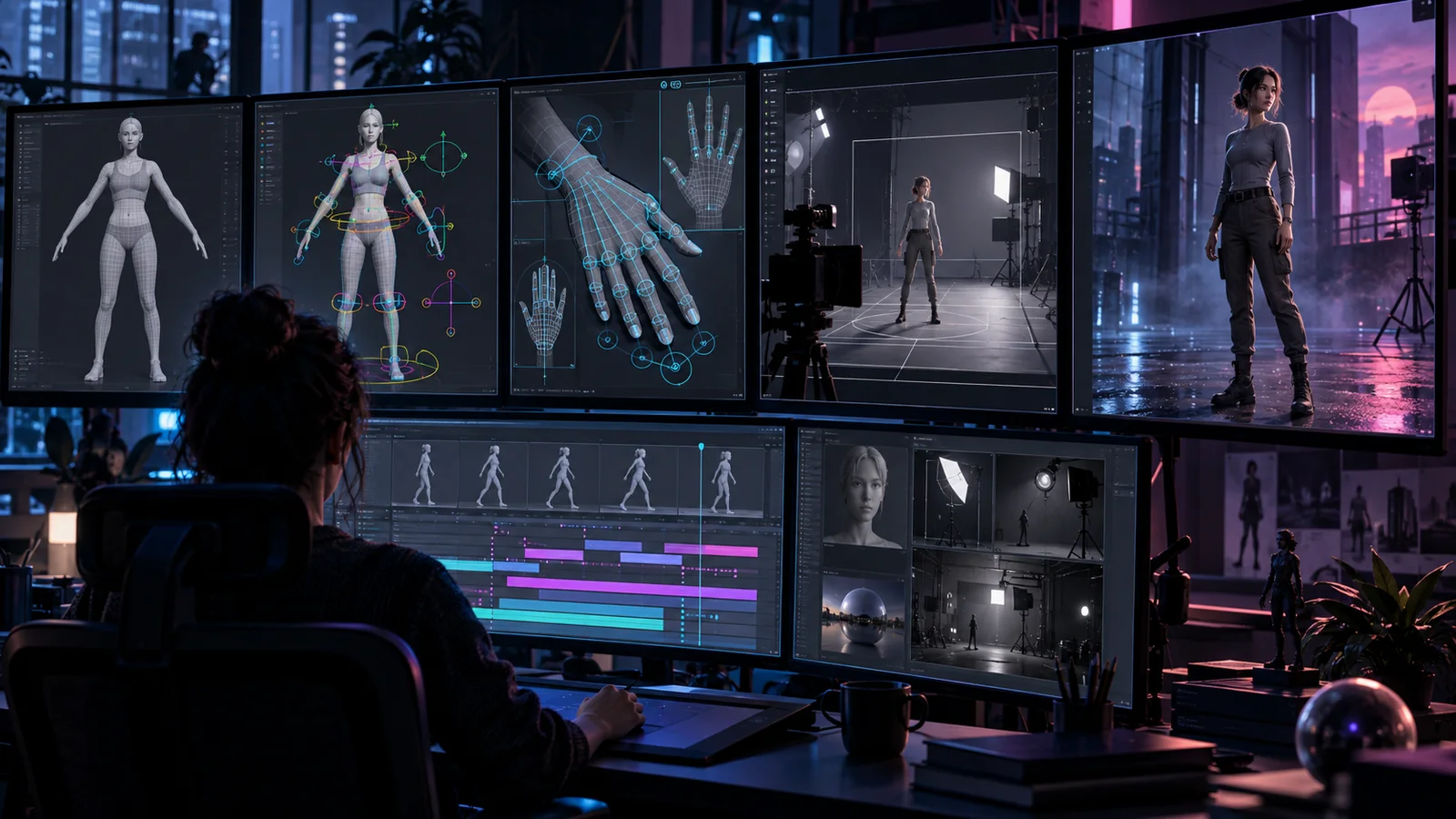
Honey Select, Honey Select 2, Koikatsu, and related Illusion products were sold as games, not as general commercial game engines. Their character makers and Studio modes nevertheless gave creators an unusually fast way to build a cast, dress characters, pose bodies and hands, arrange props, light a scene, move cameras, and capture images. Community plugins added timelines, expanded posing controls, scene organization, export tools, and other production features.
That speed matters. A solo developer can stage a conversation, revise an expression, or produce a short loop without first becoming a character modeler and rigging specialist. Koikatsu supports a stylized anime look, while the Honey Select family supports a more realistic 3D presentation. Their large mod communities widened the available clothing, hair, rooms, poses, and animation workflows.
Studio is still not a magic render button. Strong work requires composition, lighting, facial direction, continuity, camera language, cleanup, file naming, scene backups, and a repeatable animation pipeline. Hand posing and keyframed motion can take hours even when the rig already exists. More plugins also mean more version dependencies and more chances that an old scene will break on a new installation.
Licensing remains a hazard because these tools and many community assets were not necessarily sold as a conventional commercial-development library. One response has become extremely common across the genre: supporters pay Patreon or SubscribeStar for early access, while an older or completed build is released publicly for free after a delay. This 'eventually free' model has supported a remarkable number of long-running projects and appears to have persisted without widespread visible legal action against creators using it.
That history explains why the model is so prevalent, but it is not a universal license or a guarantee that every asset is safe to use. In practice, creators combine a fast and comparatively affordable production pipeline with supporter-funded early access, then make the game broadly available later. The result is an uneasy but durable middle ground that has made many ambitious adult games economically possible when a fully licensed Daz or custom-asset pipeline would have been out of reach.
Asset stores fill the gaps, but every license travels with the file
Creators who work in Blender, Unity, Unreal, Daz, or a mixed pipeline often buy models, environments, clothing, animations, sounds, and visual effects instead of building every asset internally. CGTrader, Fab, engine marketplaces, Daz, and specialist creator stores can turn months of modeling into a manageable purchase. Sketchfab remains an important place to view and share 3D work, but its former store has moved to Epic's Fab marketplace.
Buying an asset does not mean buying its copyright. The team must record the seller, product page, purchase date, license version, permitted platforms, seat limits, modification rights, attribution rules, and whether source files may be distributed. Editorial-only assets, noncommercial releases, fan conversions, and extracted game models do not become commercially safe because they fit the scene.
The same rule applies to music, voices, fonts, sound effects, and code plugins. An adult game's provenance ledger is less glamorous than its gallery, but it is what allows a successful project to move from a free build to a store release without replacing half its world.
Independent asset creators are part of the toolchain
A parallel creator economy supplies characters, clothing, anatomy, hair, environments, rigs, shaders, and tutorials through Patreon, social platforms, and personal stores. Artists such as Ryan Reos, Agent Red Girl, Lowborn, Captain Hiro, SarukaiWolf, and NoduSFM illustrate how much specialized production now happens outside the large marketplaces.
These links are starting points, not blanket license endorsements. Some pages are explicitly NSFW. Membership access, personal-use downloads, renders, commissions, and commercial game assets can all have different terms even when they come from the same artist. Before putting an asset in a game, the developer should obtain the terms that apply to that exact file and preserve them with the project.
Animation, audio, and polish create the illusion of ease
A scene does not feel alive because the character model is detailed. It feels alive because expressions change at the right moment, eye lines make sense, hands contact surfaces, bodies carry weight, loops do not visibly snap, cameras cut with purpose, and sound supports the motion. Those details sit between the asset and the final game.
Pre-rendered animation may be produced inside Daz, an Illusion-style Studio timeline, Blender, or another 3D package and then delivered as video, image sequences, or loops. Real-time games instead import rigs and clips into the engine, blend animation states, manage physics and collision, and render the result on the player's hardware. Hand-keyed animation offers control but demands time. Motion capture can accelerate some work while creating a different cleanup burden.
Audio is its own production track: music licensing, ambience, interface sounds, voice direction, editing, loudness, looping, and compression. It also matters to connected play. A scene with explicit timing events can drive a device precisely; a finished audio track can only support a more approximate sound-reactive fallback.
The invisible game is made of state, tools, and old saves
Long-running projects become databases of names, flags, affection, schedules, inventories, galleries, seen scenes, and mutually exclusive choices. A player sees a button. The developer sees every condition that decides whether the button should exist, what it should do, and whether it should work on a save created eighteen months ago.
Sustainable teams build small internal tools: scene spreadsheets, render queues, naming rules, dialogue validators, missing-image checks, save migrations, repeatable packaging, and crash reporting. Those tools rarely appear in a trailer, but they determine whether monthly updates remain possible after the project outgrows one person's memory.
Connected-device support belongs in that same event system. The game can emit scene start, pace, intensity, position, pause, climax, and stop while a local bridge handles protocols and hardware. Adding those events during production is more reliable than trying to reconstruct intent from filenames or audio after the game ships.
Why supporter builds often come before the free public build
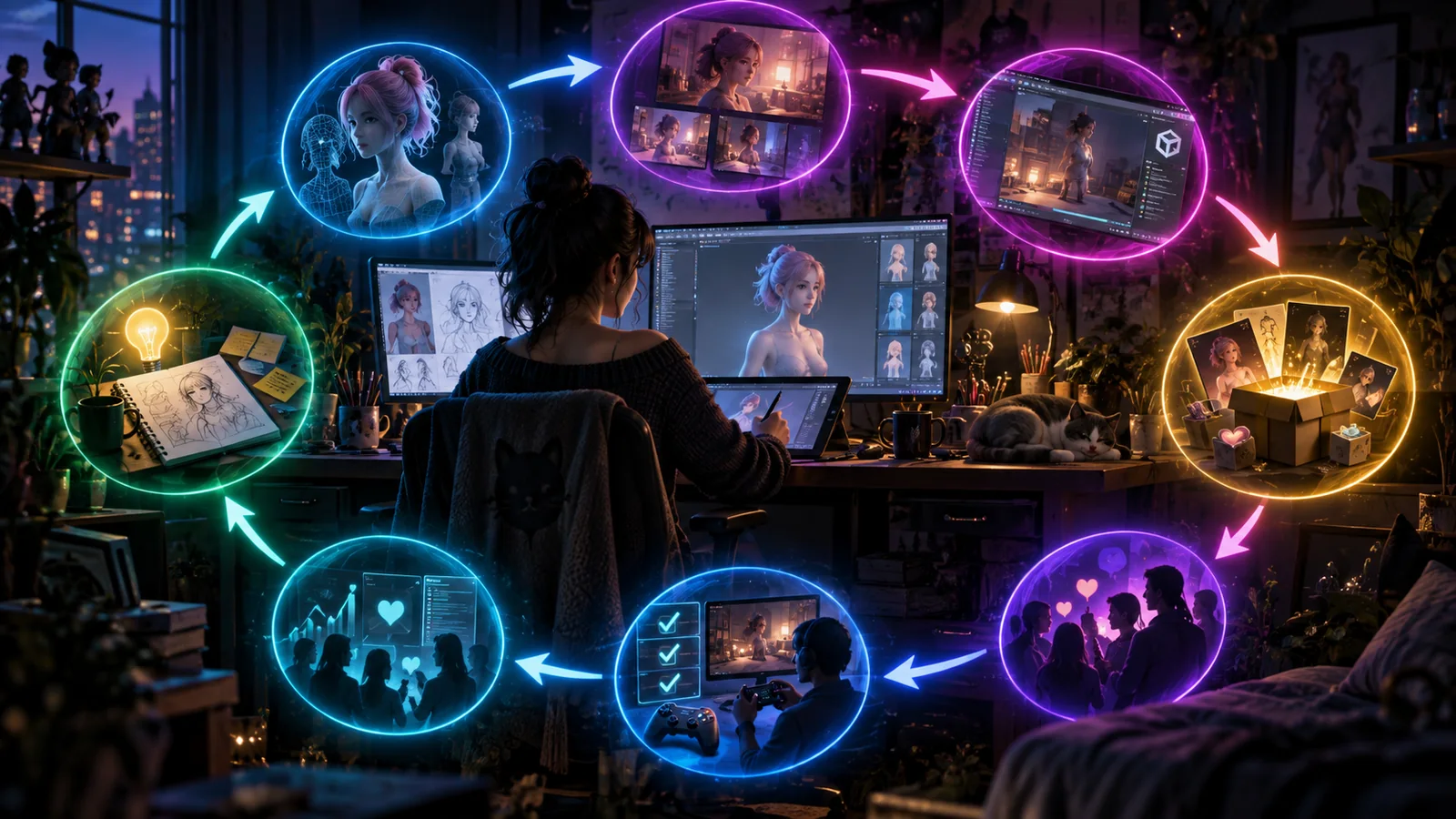
The familiar adult-game release pattern follows the economics of this pipeline. A small team incurs costs every month for software, hardware, asset licenses, commissions, rendering, music, voice work, localization, testing, hosting, and living expenses. Waiting several years for one final sale is often impossible.
Memberships turn development into a recurring exchange. Higher tiers may receive a new build first, lower tiers later, and the public may receive an older build after a delay. Supporters can also fund polls, previews, credits, behind-the-scenes posts, or a community server. The delayed free release becomes a demo and a discovery channel, while the supporter window finances the next chapter.
The model is both a funding system and a practical response to the economics and licensing uncertainty surrounding common production pipelines. It also has real costs: several live versions, old-save support, recurring deadlines, community management, refund and payment issues, and the temptation to keep expanding a project that needs an ending.
A store launch can eventually consolidate the work into a clearer product, but it may also require achievements, localization, platform-specific edits, censored and uncensored packages, external patches, and renewed quality assurance. If the original game was built with economically accessible tools or community assets whose terms do not fit a commercial storefront, the team may have to replace every character, outfit, prop, environment, or animation before it can sell the same game conventionally. For a solo developer, that can turn a store release from a sensible next step into a distant pipe dream. What looks like one game to the player may be a family of builds maintained by a very small team.
The tools lower the barrier. They do not finish the game.
Ren'Py can supply the novel framework. RPG Maker can supply the event-driven RPG framework. Daz or Studio can supply a cast and a stage. Asset stores can supply a room, an outfit, or an animation. None of them decides why a scene matters, keeps the cast consistent, repairs a broken route, supports an old save, or tells the creator when the project is complete.
That is the useful way to read an adult game's credits and files. The engine explains some of its strengths. The art pipeline explains its pace and visual language. The business model explains how the work survives between releases. The finished game is the result of all three systems being maintained long enough for the audience to experience the story rather than the machinery.
Support the games you want to see finished
The clearest way players can improve this ecosystem is simple: support creators whose work they value and obtain games through the creator's official links. Pirated copies do not fund the next scene, the next commissioned asset, better animation, professional editing, device integration, or the years of maintenance required to reach a real ending.
Not every reader can afford a monthly membership, and many creators deliberately provide public builds so people can still play. Following the project, sharing its official page, reporting bugs, leaving a thoughtful review, buying the eventual store release, or supporting for a month when possible all help. When good projects earn enough to replace borrowed-looking assets, hire specialists, license music, improve animation, and finish development, players get better games in return.